Posted in Article

New Discoveries from the Bilingual Brain and Mind across the Life Span: Implications for Education

The research article “New Discoveries from the Bilingual Brain and Main across the Life Span” by Laura-Ann Petitto was published in 2009. The article discusses neuroscience research with the goal to see if there are sensitive periods in the human development of language and reading and to understand the development and functions of brain tissue. The new field of educational neuroscience has emerged that allows us to analyze educational problems. This study shows how language research in educational neuroscience can help with educational policy and practice. Multiple studies were performed in this article. The first finding was that introducing a new language did not “damage” or “contaminate” the language first taught at home. The second finding was that bilingual babies have an “increased sensitivity to a greater range of phonetic contrasts, and extended developmental window of sensitive for perceiving these phonetic contrasts relative to monolingual children” (5). Another finding include that bilinguals who learned two languages by the age of, process the languages very similar to monolingual individuals. Bilinguals who learned a second language later “exhibit more bilateral activation, recruits more distributed frontal lobe tissue (including working memory and inhibitory areas) and recently exhibit more cognitive effort” (7).


This source is very useful in determining how the bilingual brain is different from the monolingual brain. It also shares how factors such as the age of language acquisition factors into how the brain is developed. These are essential to my guiding questions regarding the development of the bilingual brain.

Article Source:
Petitto, L.-A. (2009). New Discoveries from the Bilingual Brain and Mind across the Life Span: Implications for Education. Mind, Brain, and Education, 3(4), 185–197. Retrieved from http://search.ebscohost.com/login.aspx?direct=true&db=eric&AN=EJ862467&site=eds-live

Posted in Website

Bilingual Brains – Smarter & Faster

The article “Bilingual brains – Smarter & Faster” is written by Judy Willis on November 22, 2012. The article describes bilingualism is a gift that parents can give their children because being bilingual has shown advantages when compared to those who know one language. These advantages include an elevated level of thinking/ awareness such as an increased attentive focus and cognition. For example, “compared to monolinguals, the studied bilingual children, who had had five to ten years of bilingual exposure, averaged higher scores in cognitive performance on tests and had greater attention focus, distraction resistance, decision-making, judgment and responsiveness to feedback.” Even in MRI scans, the prefrontal cortex networks of bilingual children demonstrated greater activity. These were specifically in the the brain networks called executive functions that are used for goal-oriented behavior. The brains of bilinguals are more complex since they need to figure out not only what a word means but what patterns of the sentence and grammar, and pronunciation that needs to be used for the language being spoken. For example: “these control networks make choices, such as which memory storage circuits are the language-correct ones to activate from which to select the correct word, syntax, and pronunciation. ”

Research has shown that parents who speak a different language than English should maintain the native language in the home even if there are social pressures to limit language learning. Parents feel that learning two languages will confuse the student in learning English and also making it difficult to transfer different schools. Also, children struggled to feel like they “fit in” due to having to translate for their parents and did not want their parents to sound “ignorant.” What these parents do not know is that learning two or more languages actually “strengthen their highest cognitive brain potentials.” Parents need to be informed about the research and keep the native language in the home. The brain is like a muscle that becomes stronger after we workout our body, that “build strength, speed, and efficiency in their executive function networks.” Now the research is done on how to expose children to bilingualism in early ages .


This is really important to for my research questions, as not only are the advantages of bilingualism being more commonly known, there is a visible growth in determining how to best achieve these advantages with our own children.

Images used in the website:

Website Source:
Willis, J., M.Ed. (2012, November 22). Bilingual brains - smarter & faster. Retrieved June 25, 2019, from Psychology Today website: https://www.psychologytoday.com/us/blog/radical-teaching/201211/bilingual-brains-smarter-faster  
Posted in Website

Understanding the Bilingual Brain

The website article “Understanding the bilingual brain” is published on Psychology Today by Francios Grasjean Ph.D on September 19, 2014. This article describes the neural bases of bilingualism. First Aurturo Hernandez is introduced who is professor at the University of Houston who ” works on the underpinnings of bilingual language processing as well as second language acquisition in children and adults.” He grew up as a bilingual who spoke English and Spanish, as well as two other languages he learned later in his life. in 2013, he published a book called The bilingual Brain and answers some questions regarding his work. He asked about the latest and most interesting findings in the field and he says that “that the differences in language experience can lead to clear neuroanatomical differences.” He also describes how two languages can co-exist together peacefully and share resources; however, they compete. Meaning that knowing one language can help another language yet can mean different things too. For example, he describes his Spanish speaking friend who accidentally frightens a waitress to be careful “because he was vicious.” In Spanish, this would be that he is addictive while in English it means that he has vices. While the word is similar it can be confusing when they in fact are different. Then he tells us how stress can lead to a loss of one language but not of another. This happens due to memory being set up to remember what we need thus “languages are set to be remembered when we need them.” Also, the language that is less affected by stress is the dominant language since it has “stronger interconnections with our knowledge.” Also, the two factors that cause one language to be privileged in the bilingual brain include the proficiency of the language and the age the language was acquired.

He then goes on to discuss language mixing. A metaphor tells of a “language switch” where areas in the “prefrontal cortex, the parietal lobe and/or the basal ganglia are involved.” The issue is that usually it is very easy to switch languages which the author believes is due to external cues that trigger each language and how the brain can quickly adapt to these different cues with the appropriate response. Also, the field of cognitive neuroscience has moved away from thinking where languages are stored in the brain to how the brain, mind and human body interact (a more systems-oriented approach). In the past, mind sciences was based on the thought that the mind was like a computer. The author believes that humans are more than that, “our brains are connected to the body and as such we function as an organism.” Lastly, he thinks that we must start answering questions stated in the late 19th century such as : “How do age of acquisition, language proficiency and language control help to shape the bilingual brain ?” He wants to move away from “thinking about areas of the brain, we could start to think about cognition as a series of brain states that come and go like waves near the shore. “


This article is useful for my guiding questions as it describes how two languages interact and how and why one can be privileged than the other. This shows current research, which moves away from old approaches to understanding of the bilingual brain as a computer to one that focuses on factors that shape and interact with the bilingual brain.

Article Source:
Grosjean, F., Ph.D. (2014, September 19). Understanding the bilingual brain. Retrieved June 27,  2019, from Psychology Today website: https://www.psychologytoday.com/us/blog/life-bilingual/201409/understanding-the-bilingual-brain  
Book Mentioned in Article:
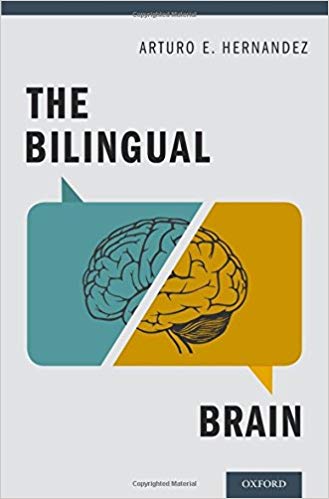
Hernandez, Arturo E. (2013). The Bilingual Brain. New York: Oxford University Press. 
Posted in Website

Bilingualism, Mind, and Brain Lab

The website called “Bilingualism, Mind and Brain Lab” is one created by Dr. Rachel Wu’s CALLA Lab. and the UC Riverside’s Cognitive Program Area as part of the school’s Department of Psychology . The lab also works with a group of psycholinguistics labs at Penn State that is part of the Center of Language Science (CLS). Through research collaborations, the lab ” investigates the cognitive processes that support the acquisition and proficient use of a second language. We study how bilingual speakers manage to speak words in one language at a time, how adult learners of a second language acquire new vocabulary, and what information is available when proficient bilinguals read in one or both of their two languages. ” The website provides research, publications, talks, recent media, research opportunities, events and volunteer opportunities.

From this website I learned that “the same neural networks that support the use of the native language also support use of a second language” (Research page). The hypotheses is that these neuron connections is the reason why it is hard for bilinguals to “turn off” a language and separate the two languages. Additionally, it would cause monolinguals who are learning a new language require an increase in cognitive resources to do so. In another section, we see that research demonstrates how “bilingualism may change minds and brains to be more open to learning, more cognitively flexible, and more resistant to cognitive decline.” (Research page). Also, “previous research has shown that bilingual older adults may show less cognitive decline in areas like cognitive control compared to monolingual older adults” (Research page). Prior to this, the belief was that speaking two or more languages can cause learners to be confused, but with these studies, we find that the bilingual brain can be a lot stronger than previously thought.


This resource specifically helps answer my guiding question about how the bilingual brain is developed by describing the neurons involved and also provides advantages to being bilingual. This source also provides a “selected publications” and “selected talks” that I can use for my own research purposes.

Picture on Welcome Page
Picture on Research Page
Website Source (Main page):
University of California, Riverside. (2016). Welcome. Retrieved June 27, 2019, from Bilingualism,  Mind, and Brain Lab website: https://bilingualismmindbrain.com/  
Website Source (Research Page):
University of California, Riverside. (2016). Research. Retrieved June 27, 2019, from Bilingualism,  Mind, and Brain Lab website: https://bilingualismmindbrain.com/research/