Posted in Creative Work

L-O-V-E by Nat King Cole

The song shown in the video “Nat King Cole L-O-V-E Multilingual Version w/ Lyrics and Translation” is one that uses English, French, German, Spanish, Italian, and Japanese. This song is about love and how each letter of the word “love” is has a phrase that he sings to show how he loves the person he is singing to. What is extraordinary about this song is that it is multilingual and shows international love. While he does not speak each language perfectly, he is spreading the love in various languages.

Song Lyrics:

L is for the way you look at me
O is for the only one I see
V is very very extraordinary
E is even more than anyone that you adore

Toi qui ne m’avais rien repondu
Je sais que tu ne m’avais pas cru

Doch, seit ein paar Tagen,
Brauch’ ich nicht mehr nach zu schlagen,
Denn, ich lieb’ nur dich allein

Quiero que me expliques por favor
Lo que enciera la palabra amor

So che non ho nulla da desiderare ancora,
Perche per me tu sei la sola donna mondiale

Loveは世界の言葉
(Love wa sekai no kotoba)
Loveは二人の宝
(Love wa futari no takara)
愛し合えば明日も明るい
(Ai shi aeba ashita mo akarui)

Love, love you love, I love you.


I choose this song to answer my guiding question since not only does it use two languages, but comes to show how multiple languages can work together in smooth manner. I feel this is a representation of how the brain works in that it can take in multiple languages, and it comes to show that being able to have multiple languages allows to not only spread “love” but also any message we want to communicate. Communicating is a huge benefit of being bilingual or multilingual.

Video Source:
Relhots. (2012, June 9). Nat King Cole L-O-V-E Multilingual Version w/ Lyrics and Translation [Video file]. Retrieved from https://www.youtube.com/watch?time_continue=39&v=kZZmhbZJwng  
Lyrics Source:
Nat King Cole:L-O-V-E (multi-Lingual version) lyrics. (n.d.). Retrieved June 28, 2019, from Fandom website: https://lyrics.fandom.com/wiki/Nat_King_Cole:L-O-V-E_(Multi-Lingual_Version)  

Posted in Article

The Developing Bilingual Brain: What parents and teachers Should Know and Do

The research article ” The Developing Bilingual Brain: What parents and teachers Should Know and Do” is about the findings of about how the bilingual brain functions in order to improve dual-language development. What is interesting is that in Europe, the knowledge of the mother tongue plus two more languages is what is recommended in education. The belief is that the ages between 6 and 12 are the best ages to learn a new language and that it should be taught intensely. Traditional ways of teaching focused on learning one language at a time due to it being “confusing and a cause for learning delays; however, now there is an increase in dual-immersion programs and thus an expansion on bilingual research and how it is “associated with higher levels of cognitive control.” In the U. S. we use use the terms “bilingual” and “dual” which is unusual for other countries who are multilingual. Compound/ simultaneous bilinguals are those who learned two languages simultaneously while sequential /coordinate bilinguals learn one language at home and another at school. The term “emergent bilingual” is becoming more popular for students who speak a different language at home as the one at school. What is understood is that the strong the first language is, the better the language will support cross-linguistic transfer to the second language. “Meaning that elements of one are used in the other.” Newer neuroscientific studies show that early exposure to a language changes the physiology of the brain. ” According to Bialystok (2009), “bilingualism is one of the experiences capable of influencing cognitive function and, to some extent, cognitive structure.”

Another section of the article talks about the bilingual advantage. First it discusses how “the brains seem to process both languages in similar regions that are associated with language processing. ” Activity was shown in the left inferior frontal cortex and medial frontal gyrus. Advantages noted include: improved working memory and flexibility with using strategies in different situations. They can do better in conflicting options and ignore certain elements. Another important quote I found was: ” while discernible differences in neural activation is termed a Bilingual Signature, the cognitive benefits of processing multiple languages have been termed the Bilingual Advantage.” The advantage is that bilinguals demonstrate better executive function (sophisticated processing like decision making and inhibition and metalinguistic awareness. (knowledge of how language functions). In addition, domain-general processing advantage (like making associations, recalling and attention) is more accurate, reacting with appropriate times, fluid switching, and performing better on tasks involving memory. Two disadvantages are noted such as smaller vocabulary in either language and slower language processing initially, but these do not continue through the process of learning. Lastly, it would be best if parents can have their child learn early in age but can still be successful in done in school.


This article is useful to answer questions regarding the advantages of the bilingual brain and how it works.

Article Source:
Mohr, K. A. J., Juth, S. M., Kohlmeier, T. L., & Schreiber, K. E. (2018). The Developing Bilingual Brain: What Parents and Teachers Should Know and Do. Early Childhood Education Journal, 46(1), 11–20. https://doi.org/10.1007/s10643-016-0833-7
Posted in Website

Understanding the Bilingual Brain

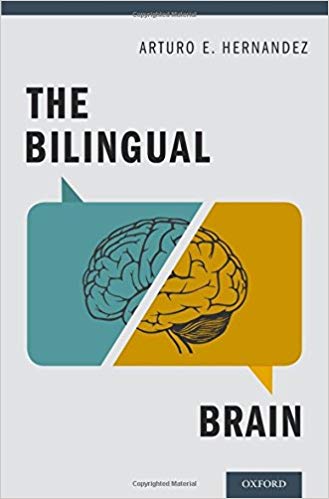
The website article “Understanding the bilingual brain” is published on Psychology Today by Francios Grasjean Ph.D on September 19, 2014. This article describes the neural bases of bilingualism. First Aurturo Hernandez is introduced who is professor at the University of Houston who ” works on the underpinnings of bilingual language processing as well as second language acquisition in children and adults.” He grew up as a bilingual who spoke English and Spanish, as well as two other languages he learned later in his life. in 2013, he published a book called The bilingual Brain and answers some questions regarding his work. He asked about the latest and most interesting findings in the field and he says that “that the differences in language experience can lead to clear neuroanatomical differences.” He also describes how two languages can co-exist together peacefully and share resources; however, they compete. Meaning that knowing one language can help another language yet can mean different things too. For example, he describes his Spanish speaking friend who accidentally frightens a waitress to be careful “because he was vicious.” In Spanish, this would be that he is addictive while in English it means that he has vices. While the word is similar it can be confusing when they in fact are different. Then he tells us how stress can lead to a loss of one language but not of another. This happens due to memory being set up to remember what we need thus “languages are set to be remembered when we need them.” Also, the language that is less affected by stress is the dominant language since it has “stronger interconnections with our knowledge.” Also, the two factors that cause one language to be privileged in the bilingual brain include the proficiency of the language and the age the language was acquired.

He then goes on to discuss language mixing. A metaphor tells of a “language switch” where areas in the “prefrontal cortex, the parietal lobe and/or the basal ganglia are involved.” The issue is that usually it is very easy to switch languages which the author believes is due to external cues that trigger each language and how the brain can quickly adapt to these different cues with the appropriate response. Also, the field of cognitive neuroscience has moved away from thinking where languages are stored in the brain to how the brain, mind and human body interact (a more systems-oriented approach). In the past, mind sciences was based on the thought that the mind was like a computer. The author believes that humans are more than that, “our brains are connected to the body and as such we function as an organism.” Lastly, he thinks that we must start answering questions stated in the late 19th century such as : “How do age of acquisition, language proficiency and language control help to shape the bilingual brain ?” He wants to move away from “thinking about areas of the brain, we could start to think about cognition as a series of brain states that come and go like waves near the shore. “


This article is useful for my guiding questions as it describes how two languages interact and how and why one can be privileged than the other. This shows current research, which moves away from old approaches to understanding of the bilingual brain as a computer to one that focuses on factors that shape and interact with the bilingual brain.

Article Source:
Grosjean, F., Ph.D. (2014, September 19). Understanding the bilingual brain. Retrieved June 27,  2019, from Psychology Today website: https://www.psychologytoday.com/us/blog/life-bilingual/201409/understanding-the-bilingual-brain  
Book Mentioned in Article:
Hernandez, Arturo E. (2013). The Bilingual Brain. New York: Oxford University Press. 
Posted in Video

Language On The Brain Podcast Episode 1: Bilingualism

The YouTube video called “Language On The Brain Podcast Episode 1: Bilingualism” is part of the Language on the Brain Podcast that from The Interesting Channel published on May 14, 2014. According to the speaker, she speaks of a balanced bilingual who learns two languages at a young age together and the dominate bilingual who learned one language first and took on a second one later in life. She states that those with “high proficiency in one or more languages would induce more focal activity in core regions of the language network in the brain whereas a lower proficiency would be accompanied by a wider distribution of activity in less core areas. ” She then speaks more of how defining bilingual is confusing since some consider it to mean having knowledge of how to speak a language versus being completely fluent in the language. She then says that it is unclear as to what it means to be fluent or the uncertainty as to what constitute as a language. She also discusses how there is debate as to whether bilingual education is good for children and how in the 1960s that bilingual education “would be detrimental to a child’s education, that they wouldn’t develop a full knowledge of either language.” She claims that there are actual cognitive advantages of multilingualism and bilingualism. For example, “it has actually been proving that the onset of various types of dementia happens later in multilingual… you keep your brain active, you use more of your brain areas.” Also, “being bilingual gives you a sense of metalinguistics, so you literally think about what you are saying,” which helps you think more deeply and make better decisions. She promotes the fact that you have exposure to foreign films and music.


This source is useful to my guiding questions as it demonstrates some basics of bilingual language, metacognition, and the brain.

Video/ Podcast Source:
Cat (Producer). (2014, May 14). Bilingualism [Show #1]. Language On The Brain. Podcast retrieved  from https://www.youtube.com/watch?v=LgmQh8SWh2A  
Posted in Website

Bilingualism, Mind, and Brain Lab

The website called “Bilingualism, Mind and Brain Lab” is one created by Dr. Rachel Wu’s CALLA Lab. and the UC Riverside’s Cognitive Program Area as part of the school’s Department of Psychology . The lab also works with a group of psycholinguistics labs at Penn State that is part of the Center of Language Science (CLS). Through research collaborations, the lab ” investigates the cognitive processes that support the acquisition and proficient use of a second language. We study how bilingual speakers manage to speak words in one language at a time, how adult learners of a second language acquire new vocabulary, and what information is available when proficient bilinguals read in one or both of their two languages. ” The website provides research, publications, talks, recent media, research opportunities, events and volunteer opportunities.

From this website I learned that “the same neural networks that support the use of the native language also support use of a second language” (Research page). The hypotheses is that these neuron connections is the reason why it is hard for bilinguals to “turn off” a language and separate the two languages. Additionally, it would cause monolinguals who are learning a new language require an increase in cognitive resources to do so. In another section, we see that research demonstrates how “bilingualism may change minds and brains to be more open to learning, more cognitively flexible, and more resistant to cognitive decline.” (Research page). Also, “previous research has shown that bilingual older adults may show less cognitive decline in areas like cognitive control compared to monolingual older adults” (Research page). Prior to this, the belief was that speaking two or more languages can cause learners to be confused, but with these studies, we find that the bilingual brain can be a lot stronger than previously thought.


This resource specifically helps answer my guiding question about how the bilingual brain is developed by describing the neurons involved and also provides advantages to being bilingual. This source also provides a “selected publications” and “selected talks” that I can use for my own research purposes.

Picture on Welcome Page
Picture on Research Page
Website Source (Main page):
University of California, Riverside. (2016). Welcome. Retrieved June 27, 2019, from Bilingualism,  Mind, and Brain Lab website: https://bilingualismmindbrain.com/  
Website Source (Research Page):
University of California, Riverside. (2016). Research. Retrieved June 27, 2019, from Bilingualism,  Mind, and Brain Lab website: https://bilingualismmindbrain.com/research/  
Posted in Video

The Benefits of a bilingual Brain

The YouTube video called “The benefits of a bilingual brain-Mia Nacamulli” is about the bilingual brain, how it develops and how it can benefit our lives. One interesting quote found in the video was “The heightened workout a bilingual brain receives through its life can also help delay the onset of diseases, like Alzheimers’s and dementia by as much as 5 years.” Through this video, I learned that there are three types of bilinguals which consist of the compound bilingual, the coordinate bilingual and the subordinate bilingual. The compound bilingual learn two languages from an early age, the coordinate bilingual learns two languages in two contexts such as home and school, and the subordinate bilingual learns a second language by filtering it through their primary language. Also, being bilingual used to be seen as a learning handicap but newer research shows that the frequent switching of the brain between the two languages causes a strengthening of the dorsolateral prefrontal cortex, which helps with problem-solving.


This resource is useful as it provides a brief overview of the bilingual brain, which helps me answer the questions on how the bilingual brain develops and what are some of the benefits that are not just social but also relating to our brain development.

Video Source:
TED-Ed. (2015, June 23). The benefits of a bilingual brain - Mia Nacamulli [Video file]. Retrieved  from https://www.youtube.com/watch?v=MMmOLN5zBLY