
Posted in Article

New Discoveries from the Bilingual Brain and Mind across the Life Span: Implications for Education

The research article “New Discoveries from the Bilingual Brain and Main across the Life Span” by Laura-Ann Petitto was published in 2009. The article discusses neuroscience research with the goal to see if there are sensitive periods in the human development of language and reading and to understand the development and functions of brain tissue. The new field of educational neuroscience has emerged that allows us to analyze educational problems. This study shows how language research in educational neuroscience can help with educational policy and practice. Multiple studies were performed in this article. The first finding was that introducing a new language did not “damage” or “contaminate” the language first taught at home. The second finding was that bilingual babies have an “increased sensitivity to a greater range of phonetic contrasts, and extended developmental window of sensitive for perceiving these phonetic contrasts relative to monolingual children” (5). Another finding include that bilinguals who learned two languages by the age of, process the languages very similar to monolingual individuals. Bilinguals who learned a second language later “exhibit more bilateral activation, recruits more distributed frontal lobe tissue (including working memory and inhibitory areas) and recently exhibit more cognitive effort” (7).


This source is very useful in determining how the bilingual brain is different from the monolingual brain. It also shares how factors such as the age of language acquisition factors into how the brain is developed. These are essential to my guiding questions regarding the development of the bilingual brain.

Article Source:
Petitto, L.-A. (2009). New Discoveries from the Bilingual Brain and Mind across the Life Span: Implications for Education. Mind, Brain, and Education, 3(4), 185–197. Retrieved from http://search.ebscohost.com/login.aspx?direct=true&db=eric&AN=EJ862467&site=eds-live
Posted in Blog

The Bilingual Advantage Blog

The Bilingual Advantage is a Blog made by Jessica Blin that contains various articles and other resources to explore regarding the bilingual language. Jessica Bin is French, Canadian, and Australian. She is also a bilingual educator at the French International School of Tokyo. Jessica has two sons. Along with her husband, they teach their sons English and French. She began the website “The Bilingual Advantage” to share her experiences with bilingualism and to guide others through that journey.

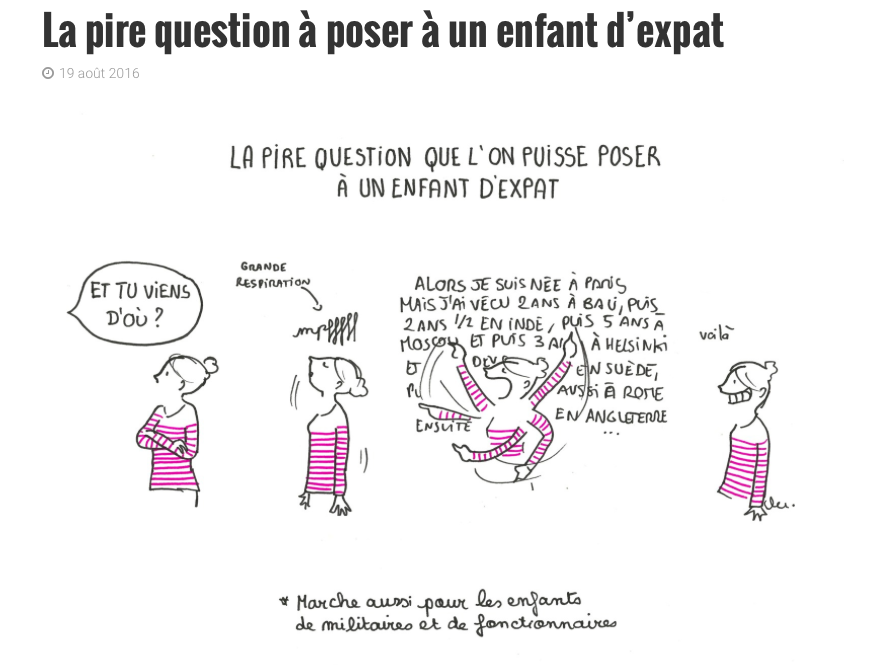
The bilingual portion of the website the following sources: “4 common mistakes parents make when raising a bilingual child,” “Are we wasting our time in language classes?,” “the importance of songs in language learning,” “So where are you from?” and “the benefits of the bilingual brain.” There are more resources than those just mentioned. If you click on “So where are you from?” you find a cartoon written in what looks like French and she translates the cartoon in English. She says” English Translation: “Where are you from?  Deep breath – So I was born in Paris but I lived in Bali for 2 years and then I lived in India for 2 1/2 years. I then lived 5 years in Moscow and  3 years in Helsinki then in Sweden, I also lived in Roma and then in England… and that’s it.” She then explains how she relates to this cartoon as she feels that she is from different places. If you click on the “the benefits of the bilingual brain,” you see a TedEd video that I had discussed in another post.


This blog is unique to my guiding questions since most articles and resources are related to the advantage of the bilingual brain. If you further explore the website, there are also resources for defining bilingualism, bilingual education and tips for bilingual parents.

Blin, J. (2019). Blog. Retrieved July 11, 2019, from The bilingual advantage website:  http://thebilingualadvantage.com/blog/