Posted in Video

How language shapes the way we think | Lera Boroditsky

Does language shape the way we think? Charlemagne, Holy emperor said “to have a second language is to have a second soul.” This means that our language creates our reality. Languages affect cognitive ability. For example, in an aboriginal community in Australia Kuuk Thaayorre in Pormpuraaw (on the west edge of Cape York), they talk in cardinal directions (not left or right) such as north, west, east, and south. Instead of saying hello, they say “which way are you going?” You respond with something like “north-north east in the far distance, how about you?” They can stay oriented very well because they are trained by their culture. Also, if they were to sort something in chronological order, they would place them from east to west (instead of left to right) in way it corresponds to their landscape.

There are languages that don’t have a number system thus not deep in mathematics. Also, Russians have different names for shades of blue while we have only the color blue. As such, Russians are faster to tell the difference between a darker and lighter blue. Their brains will show a “surprise reaction” as the color shifts from dark to light as a categorical change. Some languages have a gramatical gender. Like the sun has a feminine gender in German while a masculine one in Spanish. These genders do affect the way that language speakers perceive the world. For example, Germans described a bridge as “beautiful” and “elegant” due to its feminine gender, while Spanish speakers describe it as “long” and “strong” with its masculine gender. Languages are structured differently such as “he broke the vase” while in Spanish you say “they vase broke” since it was an accident. People of different languages pay attention to different things depending on what language requires us to do. In English we remember who did it while in Spanish we remember if it was an accident (intentions). We tend to blame more in English. The speaker states: “The beauty of linguistic diversity is that it reveals to us just how ingenious and how flexible the mind is. Human minds have invented not one cognitive universe, but 7,000 — 7,000 languages spoken around the world.” We can also create languages. We are losing one language a week, thus in 100 years we will lose half. She concludes that we reflect on how are we shaped to think and how do we want to think.


While this Youtube video does not discuss the bilingual brain specifically, it does discuss how language affects us. I include this in my studies to see the role that language has on us in determining our perceptions about the world, and how that is applicable to helping us see the role that two or more languages learned together can affect the way we see and respond to others and the world around us. This increase in perceptions is an advantage of having a bilingual or multilingual brain.

Video Source:
TED. (2018, May 2). How language shapes the way we think | Lera Boroditsky [Video file]. Retrieved from https://www.youtube.com/watch?v=RKK7wGAYP6k 

Posted in Video

Bilingual and Monolingual Baby Brains Differ in Response to Language

This video shows a study between bilingual and monolingual babies in regards to brain activity. Eleven month old babies would hear the sounds of both Spanish and English. Bilingual babies (from bilingual families) would respond to both Spanish and English sounds while Monolingual babies (who only have heard English) only respond to English sounds. Thus the infant brain of eleven months specializes in language(s) being practiced around them. Also, bilinguals showed stronger responses in the prefrontal and orbitofrontal Cortex which are associated with executive function skills and are known to activate when bilingual adults switch between two languages. Thus babies are already practice switching between to languages.

Youtube Video

This study shows how the bilingual brain is different to that of the monolingual brain in terms of activity when engaged in specific sounds. As such, it helps answer my question as to how the bilingual brain is developed.

Video Source:
I-LABS Tech Support. (2016, March 22). Bilingual and monolingual baby brains differ in response to language [Video file]. Retrieved from https://www.youtube.com/ watch?time_continue=160&v=TAYhj-gekqw 
Posted in Website

The Advantages of a Bilingual Brain

The website article called “The Advantages of a Bilingual Brain” by Laura Chaparro on April 26, 2018 talks about the positive impact that bilingualism has on individuals. Being bilingual is tied to delaying symptoms of dementia, better recovery after a stroke, better memory and attention skills, better working memory skills compared to monolinguals and the better executive functions like working with others and conflict resolution. In a study that examines micromanaging and behavioral studies on adulthood bilingualism found that “two languages protects against cognitive deterioration by improving the cognitive reserve.” Dementia is delayed by about four years as bilingualism keeps our minds and brains healthy. As for stroke recovery, 608 patients were analyzed by the Institute of Medical Sciences of Nizam (India). Of those, “40.5% of bilinguals recovered normal cognition, compared to 19.6% of monolinguals.” Regarding the brain, eleven month babies where studied at the University of Washington. They looked at babies of bilingual and monolingual families. They found that ” The prefrontal and orbitofrontal cortices (two areas of the frontal lobe) had more intense responses in bilingual babies compared to those who only heard and spoke one language. ” Also, bilingual individuals show denser grey matter on the “left interior parietal regions of the cerebral cortex” and white matter better maintained during aging. What is most interesting is the following: “Overall, bilinguals have developed different brain regions to perform tasks than the ones used by monolinguals,” Bialystok sums up. We still don’t know how these changes allow an improvement in performance and cognitive reserve for those who can speak two languages.


I chose this article as it answers my guiding question regarding the advantages of the bilingual brain. We see a delay in dementia, as well as an improvement in cognitive skills when compared to monolinguals. We also add on to the development of the bilingual brain because we now know that different regions are developed in the brains of bilinguals.

Image from the website
Chaparro, L. (2018, April 26). The advantages of a bilingual brain. Retrieved July 6, 2019, from OpenMind website: https://www.bbvaopenmind.com/en/science/research/the-advantages-of-a-bilingual-brain/   
Posted in Creative Work

Tree of Life Paradise Goddess

This creative work was used as the logo of the CABE (California Association for Bilingual Education) conference 2019. I attended this conference which is tailored to educators and administration in bilingual or multilingual contexts. The author of this art piece is Sandra Silberzweig who has many similar styles of work pictured at her website: https://sandra-silberzweig.pixels.com/


While I am unsure as to why the conference chose this image, I can imagine why this image depicts the bilingual individual. Speaking two or more languages tends naturally become part of our identity and culture. It is lively, full of energy, an additional means to connect with the world around us. These are all of these indicate a sense of beauty of the bilingual brain.

Tree of life Paradise Goddess by Sandra Silberzweig
Photo Source: 
Silberzweig, S. (2012, April 23). Tree Of Life Paradise Goddess [Illustration].
Posted in Artifact

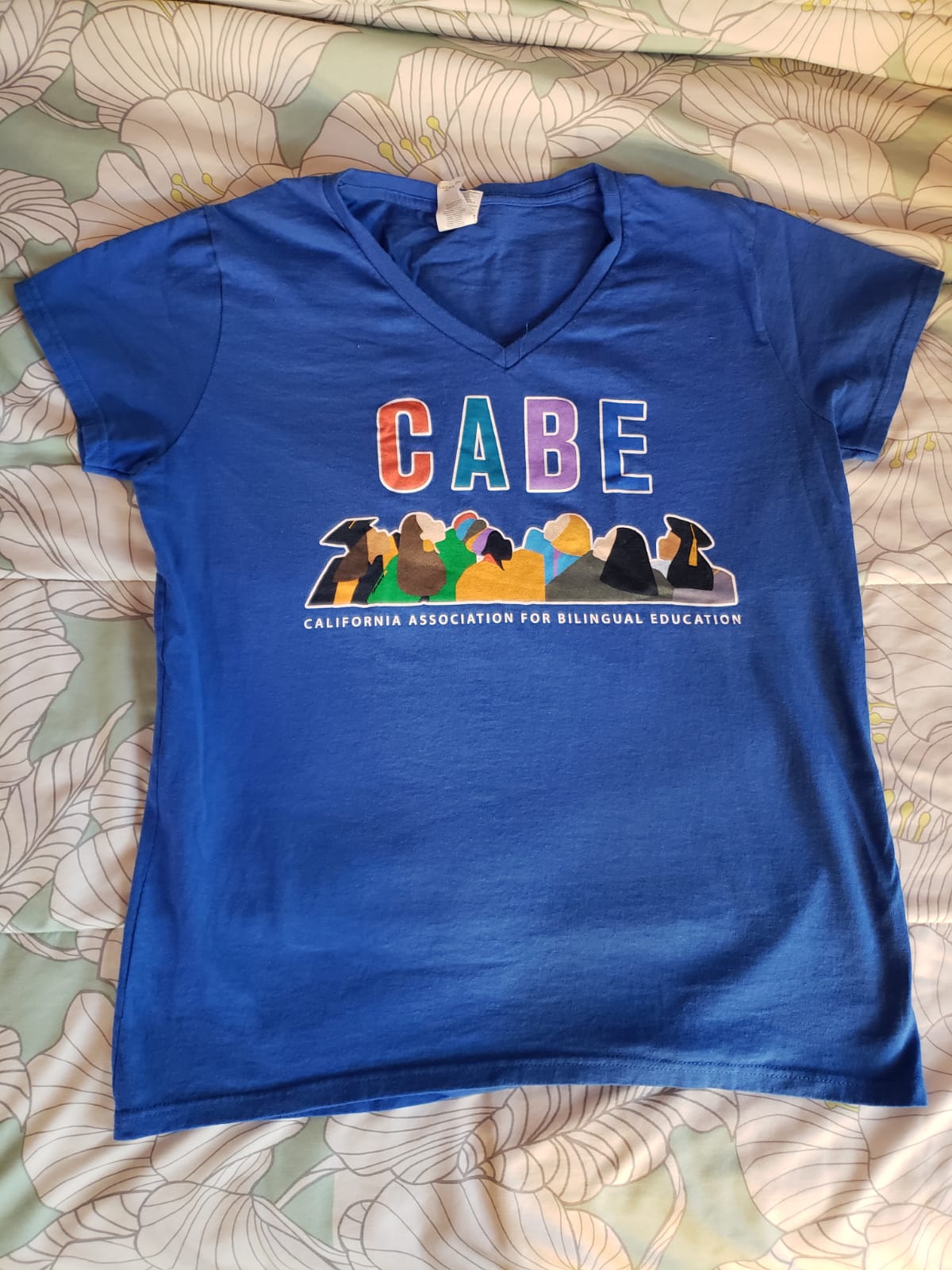
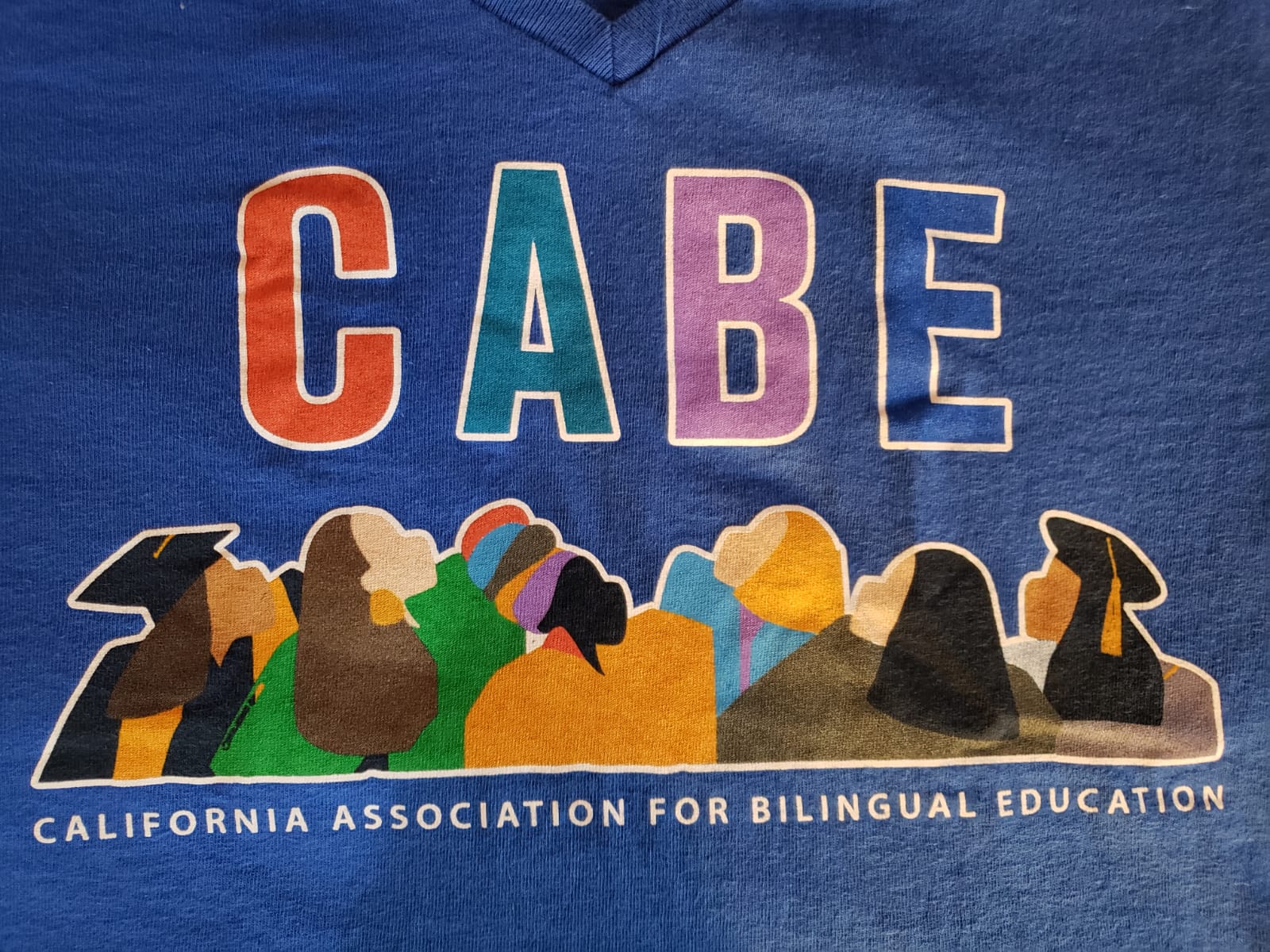
CABE T-shirt

I bought this T-shirt at a CABE Conference, which stands for the California Association for Bilingual Education. The whole conference took place in three and a half days and strives to support educators and administration who teach a second language or multiple languages.


I bought this shirt to remind me about the importance of bilingual education and the constant learning necessary to continue teaching bilingualism and biliteracy. While the shirt does not support my guiding questions, the event attended in of itself represents the advantages of the bilingual brain.

Photo Sources:  
Aguilera, J. (2019, July 5). T-shirt close up [Photograph].  
Aguilera, J. (2019, July 5). T-shirt whole [Photograph].  
Posted in Experiential

The Bilingual Brain by Arturo E. Hernandez by University of Houston System (Coursera) – Week 1

I took a free online class called “The bilingual Brain” on Coursera. Below are my notes on Lessons from week 1.

Office hours: Q&A of Instructor; A question was conducted on personality switching that occurs with language switching. Dr. Hernandez explains that different personalities come out depending on the context, not language specifically. For example, you be shy with many people around while outgoing with a friend. Personality can switch when you go home (relating to native language) to going to school (with a second language). Also, the first language is more tied to emotion. Different responses in bad words (stronger feeling in a native language). He also discusses how language impairments are apparent in any language, which does not depend on how many languages a child learns. He states: “Language impairment, to some extent, is independent of any particular language” Lastly, parents regret not maintaining the home language, and parents regret not being taught the native language. Kids can blend languages and eventually sort out the language. Parents must determine what the language outcome should be. Pushing for the native language is more work since the societal language is a stronger influence.

1.1 How are two languages coded in one brain? A guy (Arturo) spoke Italian (native language) and learned French and English as a young man. He suffered from hemiplegic stroke which caused a speech disturbance and could never recover French and English.

1.2 Jean Albert Pitres (doctor) defined familiarity as “the language that would be most resistant to damage would be the language that the patient was speaking at the time of the stroke.” He talks about how well you speak it plays a role.

1.3 Theador Ribot developed the theory “law of regression: memories learned in early life are organic.” He studied patients with dementia, more complex memories were forgotten, then the meaning of words, single words and then gestures. He had several bilingual patients, and he learned that earlier learned things are resistant to damage. For example, a forester who grew up in Poland and then moved to Germany, spoke German the rest of his life had gone through anesthesia for a surgical procedure. He then spoke Polish even though he had not spoken it in 30 years. In 1999, Franco Fabbro (in his book Neurolinguistics of Bilingualism) conducted research of many cases in the last 100 years with bilinguals who had brain damage and found that a third recovered their first language the fastest, a third their second language the fastest and a third both languages the same. Maybe it does not depend on language… So Patient A.S. spoke Farsi and learned German in college and conducted research in English. He would alternate between Farsi and German (without mixing the languages). After he fully recovered the two languages, he was able to recover English. Dr. Hernernadez was learning Portuguese in Brazil and had trouble speaking his Spanish and English native languages while doing so. Then the idea of control came up that could be called the language switch.

1.4 Otto Poetrzl introduced the language switch “a neurological mechanism that allows a speaker to remain in one language and switch to another.” Thus we can get stuck in a language, we can struggle with the idea to get out of a language by turning on a language and turning the other off. For example, there was a Czech native speaker who learned German at 14. He could understand both but can only speak Czech.

1.5 Three topics: Age of Acquisition – Law of regression, Proficiency – Familiarity, Control- Fixation. Metaphors of the mind: A computer (information possessor, like a machine), Linguistics (different language functions (sounds, words, letters, sentences) are broken by different types of damage), location (language is in different parts of the brain). Final thoughts: language is not one thing (complex, many layers, ex: sounds, letters, sentences, larger pieces of language), Language develops over time (many layers)

1.6 Bilingual Metaphor: Conflict between two languages, new languages, biological (two species coexisting in an ecosystem). Coexist, share resources.


This course is essential to answering my questions on the development of the bilingual brain and the advantages of the bilingual brain. In week 1 he lays out the foundations of the research on the bilingual brain and introduces the topics explored in the next coming lessons. We already see that studying the impact languages have on the brain is very complex.

Course Source:
Hernandez, A. E. (2019). Week 1 [Lecture transcript]. Retrieved July 6, 2019, from Cousera website: https://www.coursera.org/learn/bilingual/home/week/1 
Posted in Book

The Bilingual Brain: Language, Culture, and Identity (Book Excerpt)

The book article “The bilingual brain: language, cultura and identity” by Nairan Ramirez-Esperanza and Adrian Garcia-Sierra” was published in July 2014 (as part of the Oxford Handbooks) and begins with the fact that many immigrant parents would teach their child to not speak their native language because English was thought to be “the gateway to becoming a part of American Society” (2). However, there has been a huge push for parents wanting their child to be bilingual in the recent years. Bilingualism is defined as “the ability of an individual to speak two languages” (2). The book discusses three characteristics involved in bilingualism: “age of second language acquisition, competence in first and second languages, and cultural identity” (2). Simultaneous bilinguals learn from an early age at the same time, second language learners are those who learn a different language after 3 years of age. Language competency is defined in different ways but can include “listening comprehension, speaking, reading and writing” (3). Cultural identity is involved since cultures are associated with languages but not culture is not always internalized. BII stands for when bilinguals can integrate and find compatibility between their two cultures. This usaully depends on how much the native language is associated with social status. Also, I found the following interesting: “Hong and colleagues (Hong, Morris, Chiu, & Benet-Martínez, 2000, see also chapter 2 in this volume) showed that biculturals are able to switch their perceptions in response to cultural cues: Chinese-American biculturals display more internal attributions when primed with American icons (e.g., American flag, Superman), and more external attributions when primed with Chinese icons (e.g., Chinese dragon, Great Wall)” (3).

Being bilingual is a norm in many countries, in 2006 a study found that 50% in Europe spoke to converse in two languages and almost 30% can do an additional language, while in the U.S. 80% speak only English. While there has been a growth in language since then, this is shocking since the U.S. is multicultural. A great cause is the belief that developing two languages can cause a cognitive delay, as well as a delay in speech. Code-switching (switching between two languages) was seen as a sign of confusion. As a result of limiting multiple languages, even maintaining cultural traditions are difficult. Empirical studies have found no difference between the “achievement of developmental milestones in a variety of areas, from babbling to word prosecution” of bilinguals compared to monolinguals (6). There was a higher amount of English words for babies of 18-30 months old monolinguals, but there is a similar growth if seen when summing up the words from two languages for bilinguals.


My guiding questions are: How is the bilingual brain developed? and What are the advantages of a bilingual brain? This text answers these questions since it describes what it means to be bilingual, how bilingualism is developed and challenges misconceptions regarding how learning two langues slows down connotative development.

Book Excerpt Source:
Ramírez-Esparza, N., & García-Sierra, A. (2014). The Bilingual Brain: Language, Culture, and Identity. Oxford University Press. https://doi.org/10.1093/oxfordhb/9780199796694.013.012