
The website article “Understanding the bilingual brain” is published on Psychology Today by Francios Grasjean Ph.D on September 19, 2014. This article describes the neural bases of bilingualism. First Aurturo Hernandez is introduced who is professor at the University of Houston who ” works on the underpinnings of bilingual language processing as well as second language acquisition in children and adults.” He grew up as a bilingual who spoke English and Spanish, as well as two other languages he learned later in his life. in 2013, he published a book called The bilingual Brain and answers some questions regarding his work. He asked about the latest and most interesting findings in the field and he says that “that the differences in language experience can lead to clear neuroanatomical differences.” He also describes how two languages can co-exist together peacefully and share resources; however, they compete. Meaning that knowing one language can help another language yet can mean different things too. For example, he describes his Spanish speaking friend who accidentally frightens a waitress to be careful “because he was vicious.” In Spanish, this would be that he is addictive while in English it means that he has vices. While the word is similar it can be confusing when they in fact are different. Then he tells us how stress can lead to a loss of one language but not of another. This happens due to memory being set up to remember what we need thus “languages are set to be remembered when we need them.” Also, the language that is less affected by stress is the dominant language since it has “stronger interconnections with our knowledge.” Also, the two factors that cause one language to be privileged in the bilingual brain include the proficiency of the language and the age the language was acquired.
He then goes on to discuss language mixing. A metaphor tells of a “language switch” where areas in the “prefrontal cortex, the parietal lobe and/or the basal ganglia are involved.” The issue is that usually it is very easy to switch languages which the author believes is due to external cues that trigger each language and how the brain can quickly adapt to these different cues with the appropriate response. Also, the field of cognitive neuroscience has moved away from thinking where languages are stored in the brain to how the brain, mind and human body interact (a more systems-oriented approach). In the past, mind sciences was based on the thought that the mind was like a computer. The author believes that humans are more than that, “our brains are connected to the body and as such we function as an organism.” Lastly, he thinks that we must start answering questions stated in the late 19th century such as : “How do age of acquisition, language proficiency and language control help to shape the bilingual brain ?” He wants to move away from “thinking about areas of the brain, we could start to think about cognition as a series of brain states that come and go like waves near the shore. “
This article is useful for my guiding questions as it describes how two languages interact and how and why one can be privileged than the other. This shows current research, which moves away from old approaches to understanding of the bilingual brain as a computer to one that focuses on factors that shape and interact with the bilingual brain.

Person being interviewed
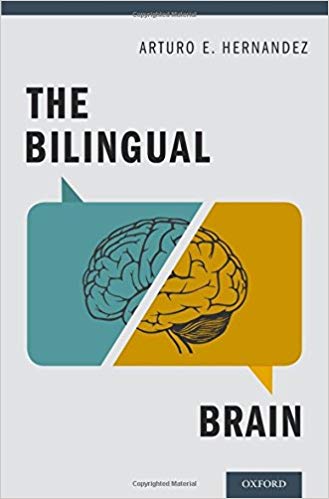
The book of the person interviewed in this article

Author of the Article
Article Source:
Grosjean, F., Ph.D. (2014, September 19). Understanding the bilingual brain. Retrieved June 27,  2019, from Psychology Today website: https://www.psychologytoday.com/us/blog/life-bilingual/201409/understanding-the-bilingual-brain
Book Mentioned in Article:
Hernandez, Arturo E. (2013). The Bilingual Brain. New York: Oxford University Press.

 My Content Resources