
The website called “Bilingualism, Mind and Brain Lab” is one created by Dr. Rachel Wu’s CALLA Lab. and the UC Riverside’s Cognitive Program Area as part of the school’s Department of Psychology . The lab also works with a group of psycholinguistics labs at Penn State that is part of the Center of Language Science (CLS). Through research collaborations, the lab ” investigates the cognitive processes that support the acquisition and proficient use of a second language. We study how bilingual speakers manage to speak words in one language at a time, how adult learners of a second language acquire new vocabulary, and what information is available when proficient bilinguals read in one or both of their two languages. ” The website provides research, publications, talks, recent media, research opportunities, events and volunteer opportunities.
From this website I learned that “the same neural networks that support the use of the native language also support use of a second language” (Research page). The hypotheses is that these neuron connections is the reason why it is hard for bilinguals to “turn off” a language and separate the two languages. Additionally, it would cause monolinguals who are learning a new language require an increase in cognitive resources to do so. In another section, we see that research demonstrates how “bilingualism may change minds and brains to be more open to learning, more cognitively flexible, and more resistant to cognitive decline.” (Research page). Also, “previous research has shown that bilingual older adults may show less cognitive decline in areas like cognitive control compared to monolingual older adults” (Research page). Prior to this, the belief was that speaking two or more languages can cause learners to be confused, but with these studies, we find that the bilingual brain can be a lot stronger than previously thought.
This resource specifically helps answer my guiding question about how the bilingual brain is developed by describing the neurons involved and also provides advantages to being bilingual. This source also provides a “selected publications” and “selected talks” that I can use for my own research purposes.
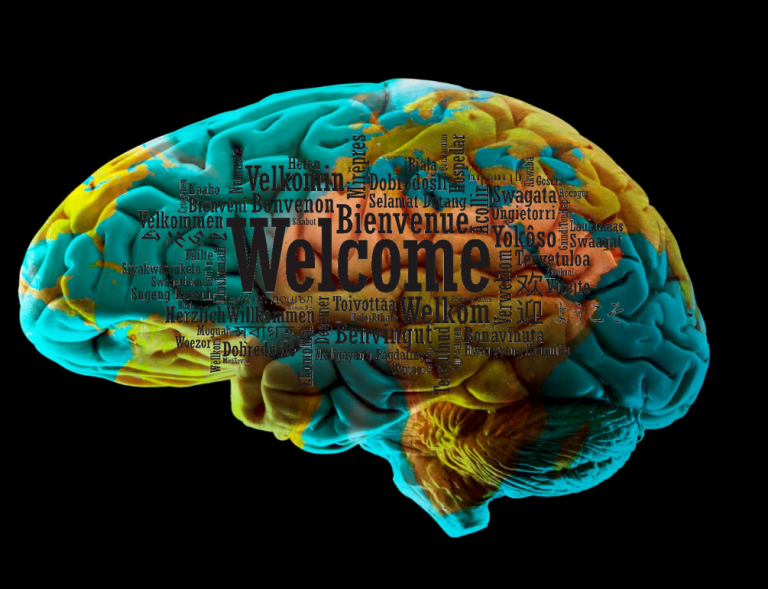

Website Source (Main page):
University of California, Riverside. (2016). Welcome. Retrieved June 27, 2019, from Bilingualism,  Mind, and Brain Lab website: https://bilingualismmindbrain.com/
Website Source (Research Page):
University of California, Riverside. (2016). Research. Retrieved June 27, 2019, from Bilingualism,  Mind, and Brain Lab website: https://bilingualismmindbrain.com/research/

 My Content Resources